
 EN
EN

Can an IHS Liner Seal an Aluminum Bottle? Yes — Test Results and the Torque Factor
Hangzhou Uniseel Technology Co., Ltd. | Technical Blog
“Can we use an induction heat seal (IHS) liner on our aluminum bottles?” That was the question a customer brought to us — and it is a bold one, because today the vast majority of aluminum bottles are still sealed with pressure-sensitive (PS) liners. We fully supported the idea, sent IHS liners together with our Unishell caps for their testing and development, and waited for the result. Their first feedback: the IHS liner could not seal the aluminum bottle mouth. We went back to our own laboratory, ran the same test ourselves — and it worked. This article explains what we proved, why aluminum bottles are more demanding than glass or PET, and the one variable that changes everything when you move from hand tightening to a production capping machine: torque.
1. The Aluminum Bottle: A Premium Packaging Trend
Aluminum bottles are increasingly popular in supplements, skincare, beverages and premium food packaging. They are lightweight, infinitely recyclable, and offer excellent protection against light, oxygen and moisture. Their brushed-metal finish projects a premium image that glass and plastic struggle to match. For sealing, the mainstream solution today is the PS (pressure-sensitive) foam liner, which bonds to the rim under compression alone. It is simple, reliable and requires no extra equipment — which is exactly why it dominates.
2. Why Consider an IHS Liner at All?
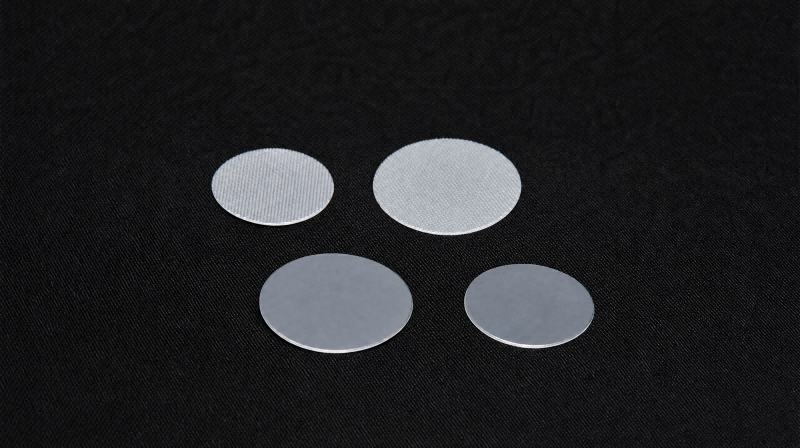
An IHS liner is a multilayer foil disc seated inside the cap. When the sealed cap passes under an induction coil, the electromagnetic field heats the foil's aluminum layer; the heat melts a polymer coating on the liner, which then bonds to the bottle rim and leaves a tamper-evident membrane across the opening. Compared with a PS liner, an IHS seal offers a truly hermetic, leak-proof barrier, superior oxygen and moisture protection, visible tamper evidence (“SEALED for YOUR PROTECTION”), and an extended shelf life — attributes that matter a great deal for premium and sensitive products.
3. The Challenge: Aluminum Is Not Glass
Induction sealing is routine on glass and PET containers. Aluminum is a different story: it is highly conductive and can couple with the induction field itself. The bottle acts as a heat sink, drawing heat away from the foil, while the metallic container can interact with the electromagnetic field in ways that make consistent foil heating harder. This physical reality is why many in the industry believe “IHS simply does not work on aluminum bottles” — and why aluminum-bottle brands have historically stayed with PS liners. But “harder” is not the same as “impossible”: with the correct liner specification, the right sealer settings and proper capping, a reliable hermetic IHS seal on aluminum is achievable.
4. Our Laboratory Test: Proof That It Works
When the customer reported that the IHS liner could not seal their aluminum bottle mouth, we re-tested the combination ourselves: our Unishell cap fitted with an IHS liner, applied to the same type of aluminum bottle. The result: a clean, hermetic seal. The foil bonded to the rim across the full circumference, remained intact with no tears or leaks, and displayed the characteristic minor creasing that is entirely normal for an induction seal — not damage. The photos and videos below document the process and the outcome.
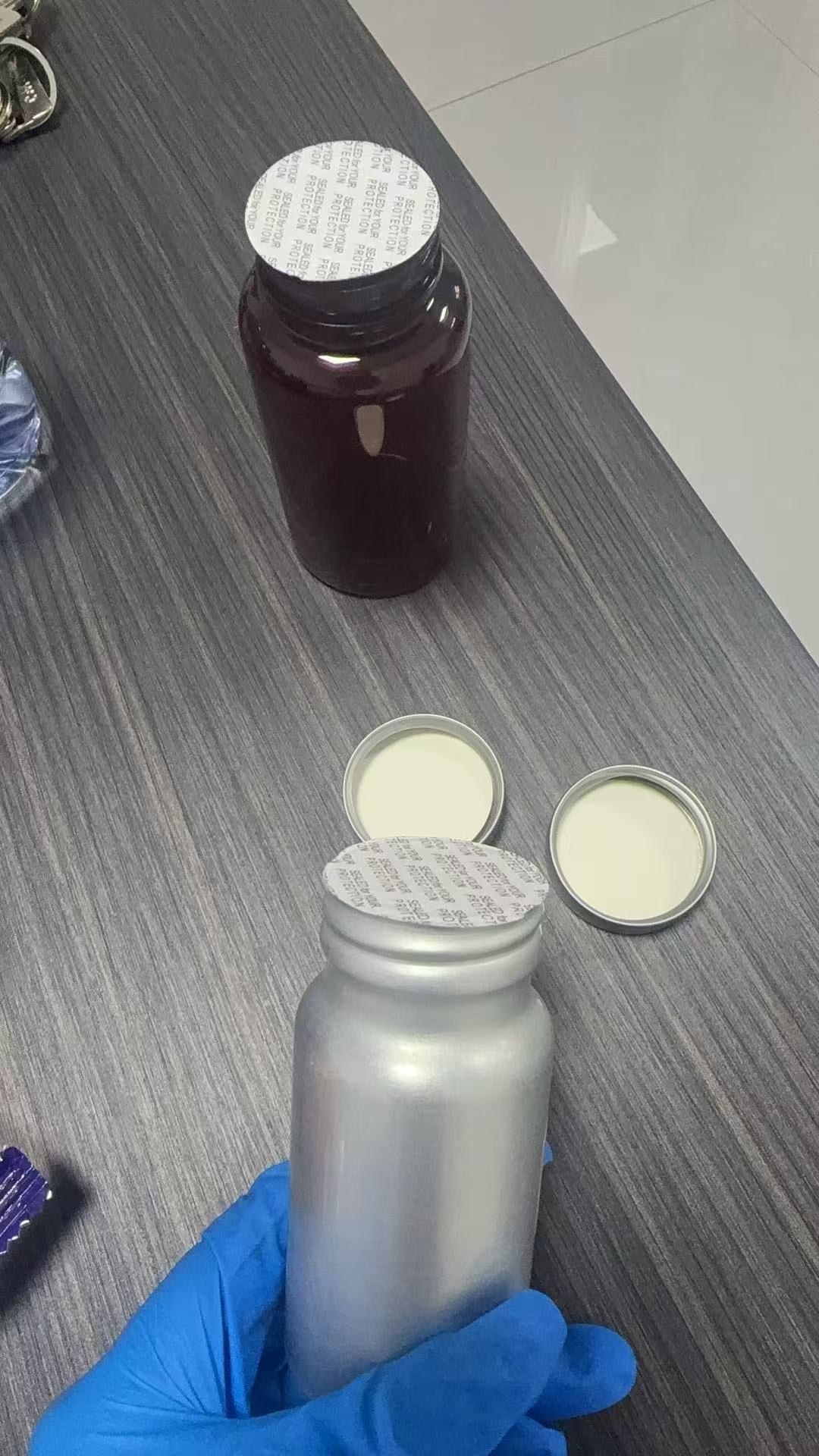
Figure 1 — Lab verification: the aluminum bottle and an amber plastic bottle, both sealed with Uniseel IHS liners (“SEALED for YOUR PROTECTION”), with the caps’ liner backings shown beside them.
Figure 2 — Video 1 (Uniseel_Induction_Foil_Sealing_Process.mp4): induction foil sealing in progress with the handheld DGYF-600 sealer on a Uniseel cap.
Figure 3 — Video 2 (Uniseel_Cap_and_Sealed_Bottle_Closeup.mp4): close-up of the sealed bottle and the cap interior with its liner backing.
Figure 4 — Video 3 (Uniseel_Sealed_Bottle_with_IHS_Liner.mp4): the aluminum bottle after sealing — the IHS foil is intact and firmly bonded to the rim.
5. The Torque Factor: Hand Tightening vs. the Capping Machine
Here is the important caveat behind our successful test: the caps in our laboratory were tightened by hand. Hand tightening applies strong, sustained and well-distributed pressure, which keeps the foil flat against the rim while the induction field does its work. On a production capping machine, that pressure is not automatic — it is a parameter you set. If the application torque is too low, or the capping head does not press the cap down before rotation begins, the foil lifts from the rim, the heat path is interrupted, and the result is a partial bond or no bond at all — exactly the symptom the customer first observed.
For machine capping, we recommend the following application torque, measured with a calibrated torque meter on the line:
Closure Size |
Target Torque (in-lb) |
Target Torque (N·cm) |
38mm (38-400) |
17 – 21 |
192 – 237 |
45mm (45-400) |
20 – 25 |
226 – 282 |
Beyond torque, three further conditions keep the seal repeatable: the capping head must compress the cap before rotating (compression-first capping); the bottle rim must be clean, dry and free of residue; and the liner must be centered and fully seated in the cap during machine feeding. A 24-hour re-check of the seal after the first line trial is the fastest way to lock in a reliable process.
6. The Path Forward for Your Project
Our conclusion is clear: IHS liners can seal aluminum bottles, provided the liner, the cap, the sealer settings and — critically — the capping torque are all controlled. We invite customers developing this application to send us their actual aluminum bottles. We will match them with the right Unishell cap and IHS liner, and we are ready to support a joint production-line trial, including torque parameter guidance for your capping machine. This is the essence of our “First Box, Full Answer” philosophy: we do not just supply closures — we engineer them to work on your line, with your bottles, from the very first box.
Frequently Asked Questions (FAQ)
Q: Can IHS liners seal aluminum bottles?
A: Yes. Our laboratory test confirmed that a Unishell cap with an IHS liner forms a clean, hermetic seal on an aluminum bottle rim when the liner specification, sealer settings and capping conditions are correct.
Q: Why do most aluminum bottles still use PS liners?
A: PS (pressure-sensitive) liners seal by compression alone, require no additional equipment and are very forgiving on the line. That simplicity is why they dominate — not because IHS cannot work on aluminum.
Q: Why did our first IHS test fail on the aluminum bottle?
A: In most cases the cause is capping-related rather than liner-related: insufficient application torque or a capping head that does not press the cap down before rotation lets the foil lift from the rim, interrupting the heat path.
Q: What is the difference between an IHS liner and a PS liner?
A: An IHS liner bonds to the rim by induction heating of its foil layer, creating a hermetic, tamper-evident membrane. A PS liner bonds purely by compression and leaves no membrane when the cap is removed.
Q: What torque should a capping machine use with an IHS liner on a 45mm cap?
A: We recommend 20–25 in-lb (226–282 N·cm) for 45/400 closures, and 17–21 in-lb (192–237 N·cm) for 38/400. Measure with a calibrated torque meter and verify the seal after 24 hours.
Q: Why did the hand-tightened lab test pass but my machine-capped bottles fail?
A: Hand tightening applies strong, even pressure that holds the foil flat against the rim during induction. A machine with low torque or no down-pressure before rotation cannot replicate that contact, so the foil fails to bond.
Q: Is the aluminum bottle itself a problem for induction sealing?
A: Aluminum is conductive and acts as a heat sink, which makes the process more demanding than on glass or PET. With the correct liner, power settings and capping conditions, consistent sealing is fully achievable.
Q: Can the same Unishell cap be used with both PS and IHS liners?
A: Yes. The same cap body can be supplied with either a PS liner or an IHS liner, depending on your sealing process and shelf-life requirements.
Q: What are the benefits of IHS sealing on aluminum bottles?
A: A hermetic, leak-proof seal, superior oxygen and moisture protection, visible tamper evidence, and an extended product shelf life — ideal for premium and sensitive formulations.
Q: How should IHS liner caps be stored?
A: Store in original packaging at 15–25°C and 40%–60% relative humidity, away from heat and direct sunlight, and use within 12 months of the production date.
Uniseel—Unified Quality, Sealed for Safety.