Case Study: A Barcelona Buyer, a 70/400 Size We Do Not Stock, and a USD 30 Sample Pack
How a straight answer about stock, a pallet-accurate quotation and a 32-piece sample pack started a working relationship - without a single promise we could not keep.
1. The short version
A packaging buyer in Barcelona, Spain asked us for 10,000 pieces of 70/400 silver unishell caps, and for 38/400 and 45/400 caps in silver and gold as its regular lines. We hold safety stock of 38/400 and 45/400. We do not hold stock of 70/400 - it is a production size for us. We told the buyer that in the first reply, quoted the size at the price it actually carries (USD 0.17 per piece from one pallet of 29,120 pieces, USD 0.16 from two pallets), and offered free samples with the buyer covering USD 30 of air freight. The buyer paid the USD 30 without further questions. We shipped 32 caps, a copy of the product test report and a declaration of compliance.
No order has been placed yet. That is not an omission in this case study - it is the point of it. What the buyer bought for USD 30 was not a discount and not a promise. It was the right to check the part before committing to a pallet, and the evidence that the company answering the inquiry is the company that makes the part.
2. What the buyer asked for, and what we actually hold
Size |
What the buyer wanted |
Our stock position |
What went in the sample box |
70/400 |
10,000 pcs, silver |
Not stocked - production only |
18 pcs, silver, PE liner |
38/400 |
Regular line, silver and gold |
Held as safety stock |
8 pcs, gold and silver |
45/400 |
Regular line, silver and gold |
Held as safety stock |
6 pcs, gold and silver |
Documents |
Not requested at inquiry stage |
Kept on file |
1 test report + 1 DoC copy |
Two of the three sizes in that inquiry are routine for us. The third one is the interesting one: 70/400 is a large-diameter closure used for wide-mouth jars, and demand for it is concentrated in a small number of customers. Holding stock of a slow-moving large diameter is expensive - it ties up pallet space and cash, and the finish (silver or gold) doubles the number of variants that would have to sit on the floor. So we make 70/400 to order, and we say so before we quote.
This is not a limitation we hide behind. It is the reason the 38/400 and 45/400 lines can be kept in stock at all: the working capital goes where the repeat demand is, instead of being spread thinly across every diameter in the catalogue.
3. The awkward part: 10,000 pieces of 70/400 does not fill a pallet
A buyer asking for 10,000 pieces is usually thinking in cartons. We quote in pallets, because that is how the size is packed and how the price steps. One pallet of 70/400 holds 29,120 pieces. Ten thousand pieces is roughly a third of a pallet - which means the first genuine price break does not start at 10,000. It starts at 29,120.
That arithmetic is the whole negotiation, so we put it in writing instead of letting the buyer discover it later:
A supplier who wants the inquiry can quietly accept 10,000 pieces at a number that looks attractive, then discover in production that the order does not cover the run. We would rather show the buyer the pallet line and let them decide whether to consolidate this size with other purchasing, or to start with one pallet. In this case the buyer's response was not to negotiate the arithmetic - it was to ask for samples.
4. What we put in writing
The quotation for the size in question, exactly as it was sent:
Product |
Order quantity |
Unit price (FOB) |
70/400 Unishell Cap - silver or gold finish with liner |
29,120 pcs (1 pallet) |
USD 0.17 / pc |
70/400 Unishell Cap - silver or gold finish with liner |
58,240 pcs (2 pallets) |
USD 0.16 / pc |
Behind those two lines sit the terms that decide whether a quotation is usable:
The buyer did not ask for a discount on the pallet price. It asked a more useful question: can we see the part first. That is a question we can answer the same day.
5. The sample pack: 32 pieces, chosen on purpose
A sample request usually arrives as 'send me one of each'. We sent a mix instead, because a sample that cannot be compared is only a souvenir.
Item in the box |
Qty |
Why it went in |
70/400 silver unishell cap, PE liner |
18 |
The size the buyer cannot buy from stock anywhere - it has to feel the thread and the liner |
38/400 gold and silver unishell cap |
8 |
Their regular line; colour reference against the 70/400 |
45/400 gold and silver unishell cap |
6 |
Their second regular line; same reference purpose |
Product test report + Declaration of Compliance |
1 each |
So their QA can start reviewing before commercial terms are discussed |
The 18 pieces of 70/400 are the centre of the pack: enough to run a sealing trial, check the thread engagement on their own jars, and see how the PE liner sits after torque. The 38/400 and 45/400 pieces are there for a different reason - they let the buyer hold the finish they already buy next to the finish they are considering, under the same light, on the same day. Colour matching across two suppliers is a real cost for a packaging buyer, and it is cheaper to settle it with 14 caps than with two pallets.
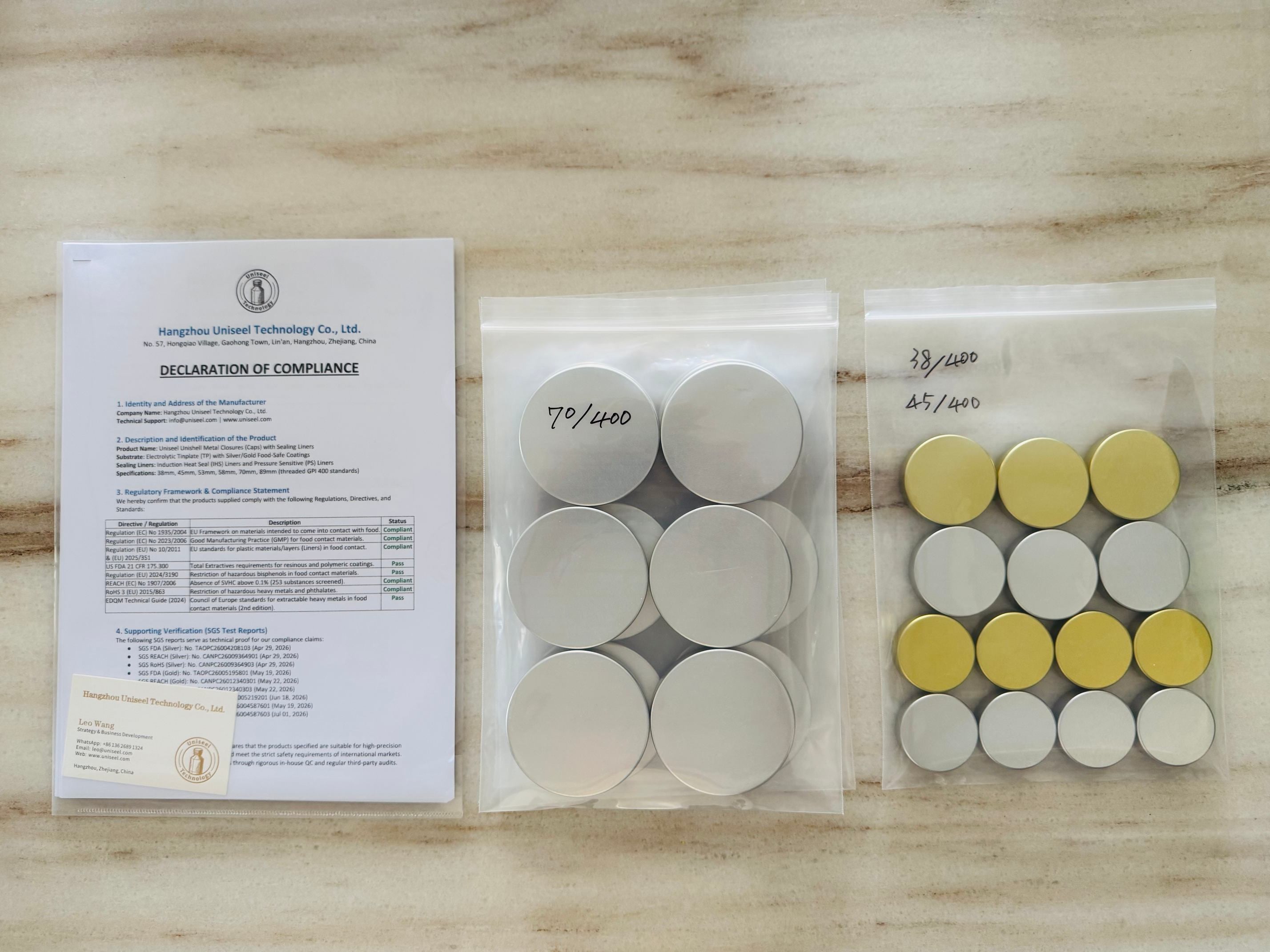
The pack as it was dispatched: 70/400 silver caps with PE liner, 38/400 and 45/400 in gold and silver, the declaration of compliance and the test report.
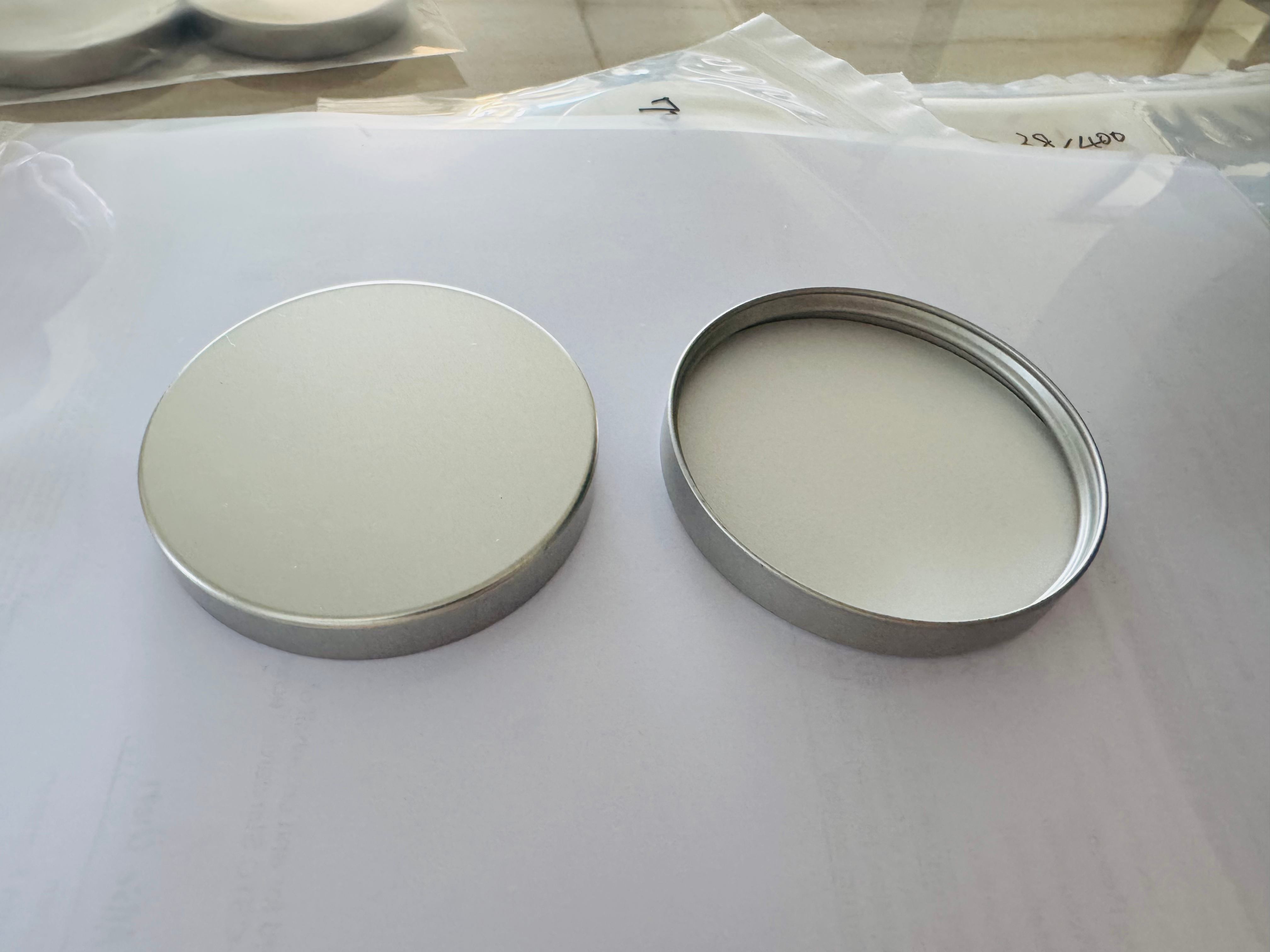
70/400 silver unishell cap: the external finish on the left, and the internal thread and liner seat on the right.
6. Why we charge USD 30 for a free sample
The samples themselves cost us nothing to give - they come off a run. The air freight does cost something, and USD 30 is our share of the conversation: the buyer pays part of the courier, we absorb the rest, the packing and the paperwork.
There are three reasons we keep it that way.
What the USD 30 does not buy is an obligation. There is no minimum attached to it, no deposit credited against a future order in this case, and no expectation that a sample turns into a purchase order. A sample is evidence, not a contract.
7. What travelled with the caps
The documents in the box are the part of a sample pack that buyers rarely mention and always check. Ours went out with the declaration of compliance and a copy of the test report; the underlying reports are on file and can be sent in full on request.
Document |
Number |
Issued |
SGS FDA 21 CFR 175.300 - silver finish cap |
TAOPC26004208103 |
29 April 2026 |
SGS FDA 21 CFR 175.300 - gold finish cap |
TAOPC26005195801 |
19 May 2026 |
SGS REACH SVHC - silver finish cap |
CANPC26009364901 |
29 April 2026 |
SGS REACH SVHC - gold finish cap |
CANPC26012340301 |
22 May 2026 |
SGS RoHS - silver finish cap |
CANPC26009364903 |
29 April 2026 |
SGS RoHS - gold finish cap |
CANPC26012340303 |
22 May 2026 |
SGS - induction heat-seal (IHS) liner |
TAOPC26004587601 |
19 May 2026 |
SGS - IHS liner, BPA-free |
TAOPC26004587603 |
1 July 2026 |
SGS - pressure-sensitive (PS) liner |
TAOPC26005219201 |
18 June 2026 |
Two certificates sit behind those reports, and they are held by different entities on purpose. The quality management system certificate (ISO 9001:2015, No. 07625Q1617R0S-ZJ/001, valid to 13 July 2028) is held by the manufacturing company, because what is certified is the production of metal bottle caps. The CE certificate of conformity (No. SC-ROHS-2026-06-02, RoHS Directive 2011/65/EU, valid to 2 June 2031) is held by the exporting company, because what is certified is the product as placed on the market. A buyer who checks both numbers will find the same group behind them.
The declaration of compliance that travelled with this pack covers the framework a European packaging buyer is audited against: Regulation (EC) 1935/2004 on food-contact materials, Regulation (EC) 2023/2006 on good manufacturing practice, Regulation (EU) 10/2011 on plastics, Regulation (EU) 2025/351, US FDA 21 CFR 175.300, Regulation (EU) 2024/3190 on bisphenol A, REACH (EC) 1907/2006, RoHS 3 (EU) 2015/863 and the EDQM Technical Guide 2024, each with its compliance status recorded against it. That is the document that lets a QA department open a file before a single commercial term has been agreed.
8. What this case actually demonstrates
It would be easy to write this up as a story about a nice customer in Spain. The more useful reading is that four things happened in a fixed order, and the order is the policy.
9. The sequence, step by step
The case ran in seven steps. The durations are deliberately not stated here - what matters for a buyer reading this is the order of events, not our internal turnaround.
Step |
What happened |
Who moved first |
1 |
Inquiry from Barcelona: 10,000 pcs of 70/400 silver, plus 38/400 and 45/400 in silver and gold |
Buyer |
2 |
Stock position stated plainly: 38/400 and 45/400 are stock lines, 70/400 is production only |
Uniseel |
3 |
Quotation issued at pallet quantities: USD 0.17 at 29,120 pcs, USD 0.16 at 58,240 pcs |
Uniseel |
4 |
Sample offer: product free, USD 30 air freight paid by the buyer |
Uniseel |
5 |
USD 30 paid without further questions |
Buyer |
6 |
Pack built: 18 + 8 + 6 caps, one test report, one declaration of compliance |
Uniseel |
7 |
Dispatch, with the tracking number and the documents in the same box |
Uniseel |
What happens next is the buyer's decision, and we are not going to pre-empt it in a case study. The honest position is that this inquiry has produced a sample, a set of documents and a conversation about pallet quantities - which is exactly what a first transaction should produce.
10. Frequently Asked Questions
Q1. Do you keep 70/400 unishell caps in stock?
No. 70/400 is a production size for us. The sizes we hold as safety stock are the high-run lines - 38/400 and 45/400 in silver and gold - because that is where repeat demand sits. 70/400 is made to order, and we state that before quoting.
Q2. What quantity does a 70/400 order start at?
The first published price break is one pallet: 29,120 pieces at USD 0.17 per piece. Two pallets, 58,240 pieces, are USD 0.16 per piece. Both prices are FOB Shanghai / Ningbo, silver or gold finish, liner included.
Q3. Why was a 10,000-piece request quoted at pallet prices?
Because 10,000 pieces is about 34% of a 70/400 pallet, and the setup and packing cost is the same whether the run is 10,000 or 29,120. We do not publish a partial-pallet price, so the honest answer is the pallet price - stated as a pallet, not disguised as a per-piece 'from' price.
Q4. Are samples free?
The caps are free. The buyer covers the air freight - USD 30 in this case - and we absorb the packing, the paperwork and the rest of the courier cost. No minimum order is attached to the sample.
Q5. What was in the sample pack?
Thirty-two caps in total: 18 pieces of 70/400 silver with PE liner, 8 pieces of 38/400 in gold and silver, 6 pieces of 45/400 in gold and silver, plus one copy of the product test report and one declaration of compliance.
Q6. Which documents come with a sample?
The declaration of compliance and a copy of the test report travel in the box. The full SGS reports are on file - FDA 21 CFR 175.300, REACH SVHC and RoHS for both silver and gold finishes, plus the liner reports - and can be sent in full on request, together with the ISO 9001 and CE certificates.
Q7. What is the lead time for a 70/400 production run?
21-35 days after the 30% T/T deposit, with the 70% balance due before shipment. Production capacity is 250,000 pieces per day, so the constraint on a pallet order is scheduling rather than capacity.
Q8. Can I buy 38/400 and 45/400 in smaller quantities?
These are our stock lines, so smaller quantities are realistic. Exact availability, finish and price are confirmed per order against current stock - we would rather quote what is on the floor than promise a date we cannot hold.
Q9. Do you name your customers in case studies?
No. This case is published with the city and country only - Barcelona, Spain - and no company name, contact or order value that could identify the buyer.
Q10. How do I request a sample for my own size?
Send the neck finish you use, the liner you need (induction heat-seal, pressure-sensitive or aluminium foil), the finish you want (silver or gold) and the quantity you are planning. We will confirm whether it is a stock line or a production size, quote it, and put the sample pack together with the documents.
Uniseel—Unified Quality, Sealed for Safety.

 EN