Closing the Gap: Layered Liner Solutions for Aluminum Bottle Closures
Case Study | Pressure-Sensitive Liners + Paper & PE Backings | South America
A South American customer who packages premium products in aluminum bottles recently put our 38mm unishell caps with pressure-sensitive (PS) liners through a full capping-line trial. The first phase of that program went well: 216 production-matched samples ran smoothly on their line, and the customer was pleased with the engagement of the cap threads. Then came a more subtle observation - one that only a meticulous packaging engineer would notice.
After torque testing and visual inspection, the customer reported that the PS liner and the bottle mouth felt as if there was a slight gap between them. It was not a leak test failure. It was not a torque failure. It was a fit-and-finish observation: the seal interface did not feel as tight as it should against the rim of an aluminum bottle.
The first thing we explained to the customer is that a small degree of compression is not a defect. A pressure-sensitive liner is engineered to deform slightly under application torque. That viscoelastic compression is exactly what spreads the adhesive across the rim and creates the contact seal. In other words, PS liners are supposed to become thinner under pressure - it is a feature, not a fault.
Aluminum bottles, however, raise the difficulty level. Compared with precision-molded glass or PET finishes, aluminum rims can carry a deeper thread finish and a less uniform sealing surface. Small surface irregularities, burrs from the curling operation, or an unusually deep neck finish mean that the liner stack inside the cap must do more work: it must span a larger sealing land and conform to micro-imperfections that a smooth glass rim would never present. If the standard liner is too thin to fill that space completely, the fit can feel - and occasionally be - less intimate than the customer expects.
Rather than simply asking us to fix it, the customer proposed a solution. Why not add a paper liner between the unishell cap and the PS liner? The paper wadding would add thickness to the liner stack, filling the deeper aluminum finish, while the PS liner on top would continue to provide its pressure-sensitive contact seal against the rim.
We took the idea seriously - and put it on the bench. Our technical team assembled caps with the PS + paper liner combination, applied controlled torque, and inspected the interface across multiple aluminum bottles from the customer's own production samples. The result was clear: the solution is completely viable. The paper backing adds the missing thickness, conforms to the rim profile, and the combination eliminates the perceived gap while preserving the sealing performance of the PS liner. It is a textbook example of a customer-driven engineering win.
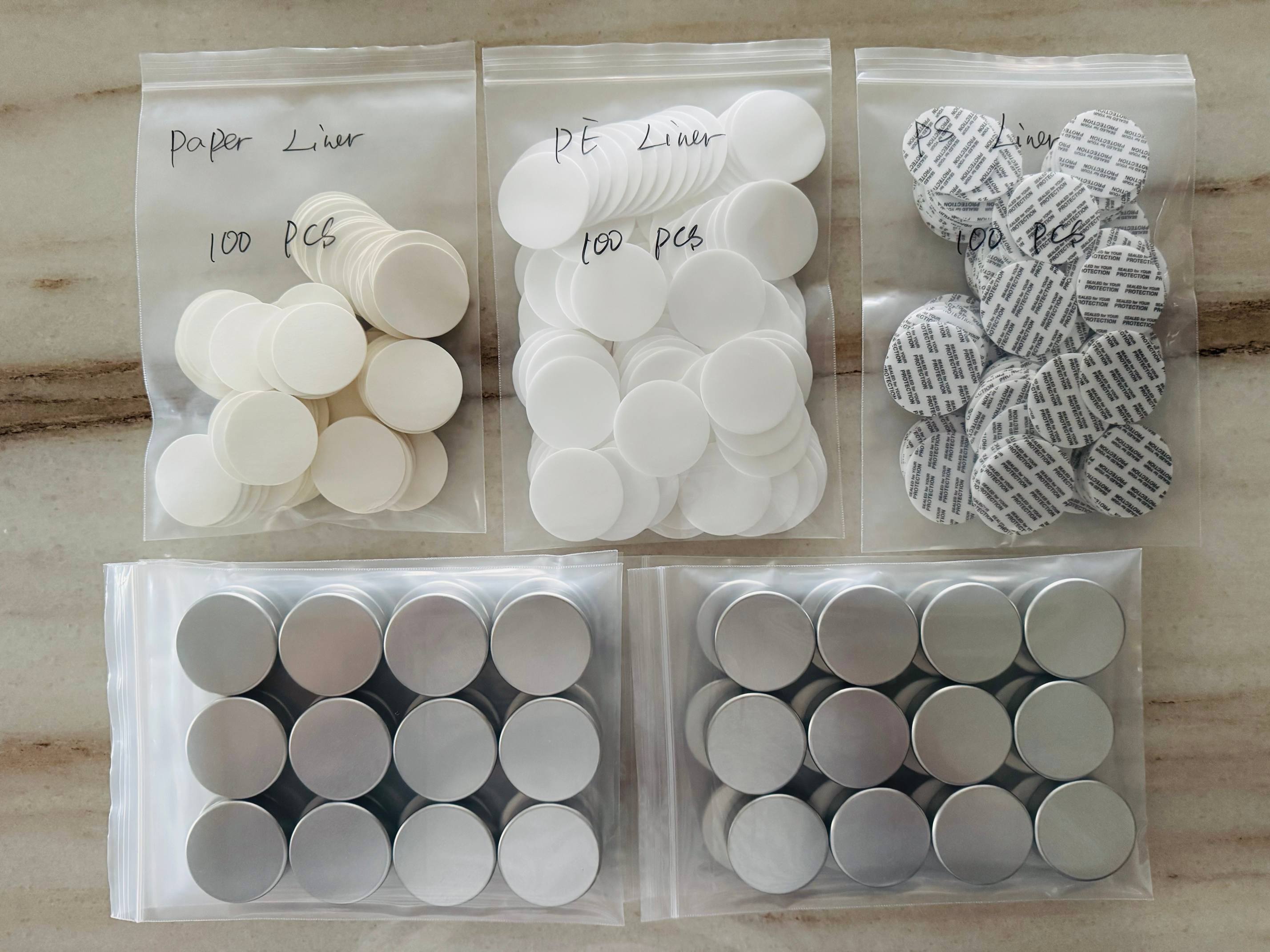 Figure 1 - Liner sample kit: Paper liner, PE liner and PS liner (100 pcs each) with aluminum bottles for side-by-side line testing.
While validating the paper-backed approach, we prepared a second option that the market may find even more attractive: polyethylene (PE) liners. PE liners are thicker than paper wadding and substantially more elastic. That elasticity gives them two advantages for aluminum bottles. First, they absorb more of the dimensional variation of a non-smooth rim. Second, they maintain consistent back-pressure over the life of the closure, which helps keep the PS layer in intimate contact with the rim under repeated handling.
Both solutions were tested in our laboratory with the customer's aluminum bottles, and both passed. The choice between paper and PE now comes down to the customer's priorities: paper is the economical, natural-material option; PE offers extra thickness, elasticity and a slightly softer feel on application.
Because a closure is only half of the seal equation, we did something that goes beyond a standard sampling exercise: we shipped the samples not only to the customer but also to the aluminum bottle manufacturer. The kit contains four elements, each labeled and documented:
Every bag is hand-labeled with its contents, and the package travels with a Declaration of Compliance covering EU and FDA regulatory standards, backed by our SGS test reports. Sending the same kit to the bottle factory matters: the bottle maker can verify the liner stack against its own rim tolerances on its own equipment, so the solution is validated at both ends of the supply chain before any production commitment.
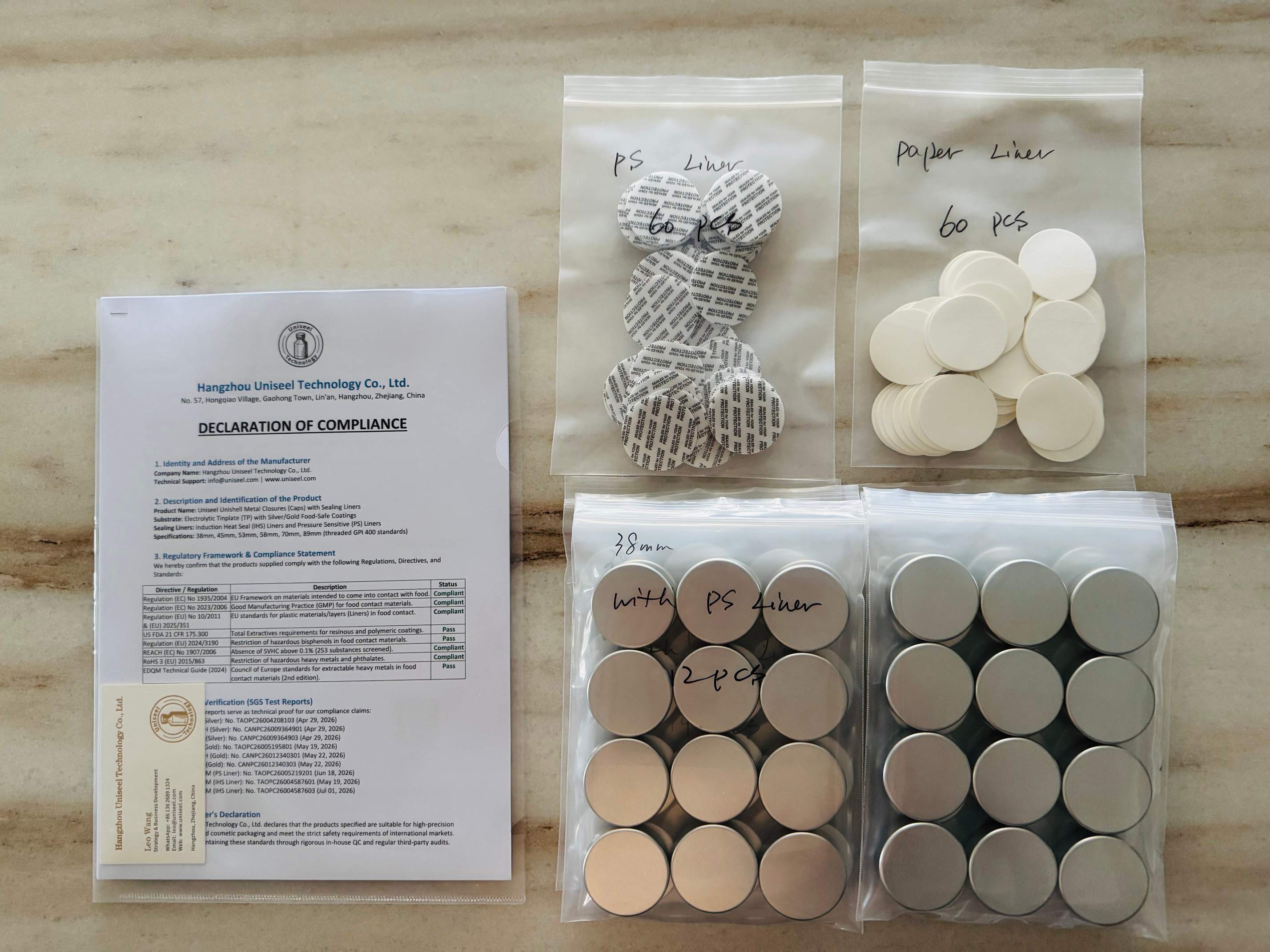 Figure 2 - The complete sampling package: labeled bags of PS liners, paper liners and 38mm unishell caps, shipped with the Declaration of Compliance to the customer and the bottle manufacturer.
Engineering partnership beats off-the-shelf packaging.
The customer came to us with a hypothesis; we tested it, confirmed it, and improved it. That is the working relationship we build with every packaging line we support.
Aluminum bottles demand a thicker seal interface.
Deeper finishes and less uniform rims mean the liner stack must be engineered, not assumed. A paper or PE backing turns a standard PS cap into a custom-fit solution.
Both ends of the supply chain should be involved.
Validating the closure against the bottle manufacturer's own tolerances removes surprises at the filling plant.
Options are better than single answers.
Paper for economy and natural materials; PE for thickness and elasticity. The customer chooses; we supply both.
A perceived gap between a PS liner and an aluminum bottle rim turned out to be an opportunity to engineer a better closure - not a problem to negotiate. By adding a paper liner backing - and by preparing a PE liner alternative - Uniseel converted a customer observation into two validated solutions, both proven in our laboratory and shipped as complete sample kits to the customer and the bottle factory. If your packaging presents a rim that standard liners cannot fully embrace, we would welcome the same kind of challenge. Sometimes the best innovation starts with a customer's question.
Q1: Why does my PS liner leave a gap on aluminum bottle rims?
PS liners compress under application torque by design. Aluminum rims often have deeper finishes and less uniform surfaces than glass or PET, so a standard-thickness liner may not fill the sealing land completely, which can be felt as a gap.
Q2: What is a paper liner used for in cap construction?
A paper (wadding) liner sits between the cap shell and the functional liner. It adds thickness, fills deeper rim finishes and helps conform the seal stack to surface irregularities.
Q3: Can I combine a PS liner with a paper liner in the same cap?
Yes. This is exactly the configuration our customer proposed and we validated: the paper backing adds thickness while the PS liner provides the pressure-sensitive contact seal against the rim.
Q4: What is the difference between a paper liner and a PE liner?
PE (polyethylene) liners are thicker, more elastic and slightly softer than paper wadding. PE absorbs more dimensional variation and maintains back-pressure longer; paper is economical and made from natural material.
Q5: Why are aluminum bottle rims harder to seal than glass?
Aluminum finishes can be deeper and less uniform, with small surface irregularities from the forming or curling process. The liner stack must span a larger area and conform to those imperfections.
Q6: Does adding a paper or PE liner change application torque?
The liner stack adds a small amount of compressible thickness. Torque should be re-verified on the production line; in our tests the recommended application torque remains within the normal working range and removal torque stays user-friendly.
Q7: Which liner combination is best for aluminum bottles?
It depends on the rim profile. If only thickness is missing, a PS + paper combination works well. If the rim is irregular or flexibility is needed, a PS + PE stack or a thicker PE-backed construction is the more robust choice.
Q8: Are paper and PE liners food-contact compliant?
Yes. Uniseel metal closures and sealing liners comply with EU and FDA regulations for food and supplement contact, and are verified by SGS test reports that accompany every sample package.
Q9: Can Uniseel supply caps with the liner stack pre-assembled?
Yes. We can supply unishell caps with PS, paper or PE liner stacks assembled at the factory, so the customer receives a ready-to-cap closure rather than separate components.
Q10: How should customers test the liner samples?
Run the sample caps on the actual capping line at the recommended torque, store 24 hours, then check removal torque and seal integrity. Testing the same kit at the bottle factory validates rim tolerances at the source.
Uniseel - Unified Quality, Sealed for Safety.

 EN
EN