 EN



France Packaging EPR Meets PPWR: What Uniseel’s 2026 Léko Membership Means for European Buyers
Direct answer: Uniseel’s 2026 Léko membership certificate confirms participation in France’s household-packaging Extended Producer Responsibility (EPR) system. It is an important market-access and producer-responsibility document, but it should not be described as a stand-alone “PPWR certificate.” Instead, it forms one part of a wider compliance framework that also includes packaging design, material safety, recyclability, labelling, documentation and national reporting obligations under Regulation (EU) 2025/40.
For European packaging buyers, the distinction matters. The EU Packaging and Packaging Waste Regulation (PPWR) creates a common direction for packaging placed on the Union market, while France continues to operate a national EPR structure for household packaging and graphical papers. A supplier that understands both levels can support procurement teams with clearer evidence, fewer documentation gaps and more practical preparation for packaging projects in France.
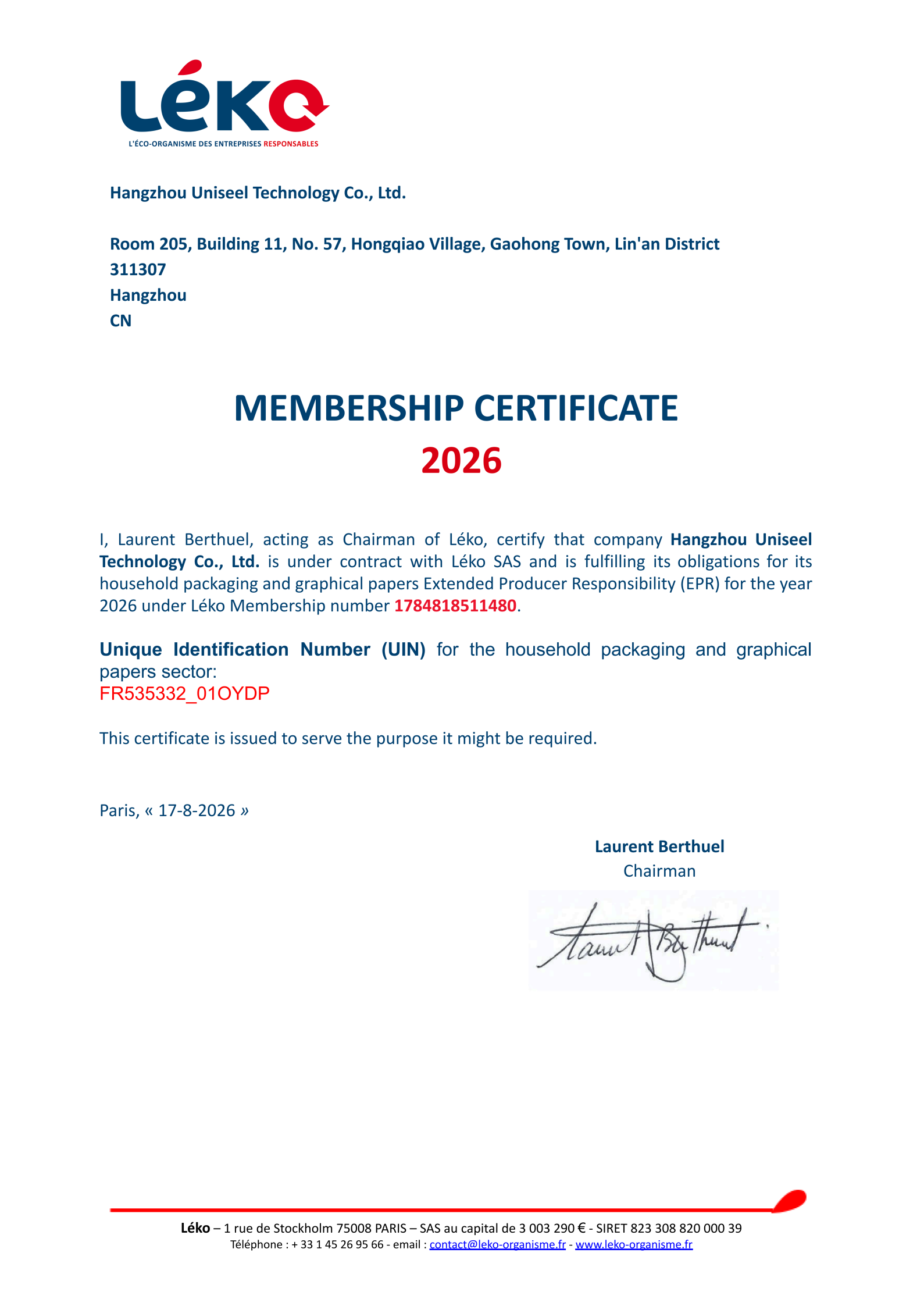 Uniseel’s 2026 Léko membership certificate for the French household-packaging and graphical-paper EPR sector.
What does the 2026 Léko certificate verify?
The certificate, issued in Paris on 17 August 2026, identifies Hangzhou Uniseel Technology Co., Ltd. as being under contract with Léko SAS for the 2026 compliance year. It states that the company is fulfilling obligations for household packaging and graphical papers Extended Producer Responsibility. The document shows Léko membership number 1784818511480 and the French Unique Identification Number (UIN) FR535332_01OYDP.
Léko describes itself as a French government-approved eco-organisation serving the household-packaging and paper sector. In practical terms, joining such an organisation helps an obligated producer participate in the national framework used to finance and organise end-of-life management for packaging placed on the French market.
For a buyer, distributor or brand owner, this certificate is therefore useful evidence that the named company has taken a concrete national EPR step. It can support supplier due diligence, onboarding, marketplace checks and internal compliance files.
How do France EPR and the EU PPWR fit together?
Regulation (EU) 2025/40 on packaging and packaging waste entered into force on 11 February 2025 and generally applies from 12 August 2026. According to EUR-Lex, it covers packaging placed on the EU market and packaging waste regardless of packaging type or material. Its purpose is broader than waste fees alone: it addresses packaging across its life cycle, including sustainability, substances of concern, packaging minimisation, recyclability, reuse and labelling.
France EPR and PPWR are related but not interchangeable. PPWR establishes the EU-wide regulatory framework. National systems remain the operational route through which producers may register, report quantities and finance packaging-waste management in a particular Member State. For businesses selling packaged products in France, understanding only the EU regulation without understanding the French EPR system can leave a practical compliance gap.
Topic |
What it covers |
What buyers should verify |
EU PPWR |
EU-wide packaging sustainability and waste rules |
Design, material, recyclability, labelling, documentation and applicable transition dates |
France packaging EPR |
National producer-responsibility participation and financing |
Registration/UIN, eco-organisation membership, reporting scope and annual validity |
Product compliance |
Evidence for the specific closure, liner and application |
Specifications, food-contact tests, restricted substances, traceability and compatibility |
Why should packaging buyers care about EPR evidence now?
PPWR-related search demand is increasingly driven by practical buyer questions: “Is this packaging ready for the EU?”, “Who carries the EPR obligation?”, “Can the supplier provide evidence for France?”, and “Does the packaging design support recycling?” These are not abstract legal questions. They affect vendor approval, product launches, marketplace listings, private-label programmes and the cost of correcting documentation after production.
A useful supplier response should therefore combine regulatory evidence with engineering evidence. EPR membership demonstrates participation in a waste-responsibility system. Technical files demonstrate what the packaging is made from and how it performs. A complete procurement file may include closure dimensions, coating information, liner structure, food-contact declarations where relevant, REACH/RoHS data, batch traceability and container-closure test results.
What does PPWR preparation mean for metal caps and liners?
A metal closure is only one component of the complete packaging system. Its PPWR relevance cannot be judged only by saying “metal is recyclable.” The cap shell, internal coating, liner, adhesive, decoration and the container itself all influence material compatibility, separation, recycling behaviour and product protection. Buyers should evaluate the complete pack rather than a component in isolation.
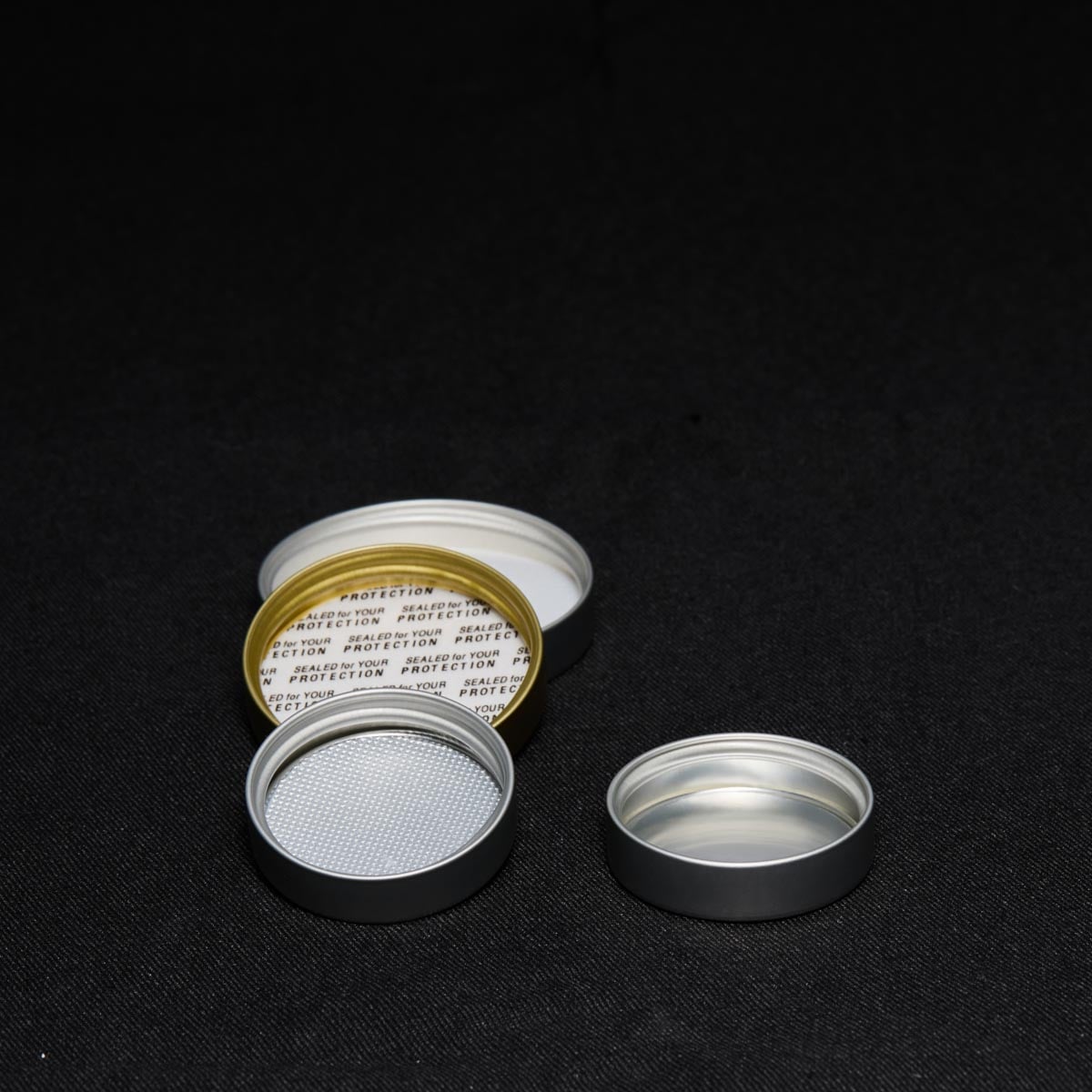
At Uniseel, closure development begins with the actual container neck finish and end-use conditions. A pressure-sensitive liner, an induction heat seal liner or a PE liner can behave differently depending on the bottle material, rim smoothness, filling product, application torque and sealing equipment. Sample-stage verification helps reduce the risk of leakage, incomplete adhesion or an unsuitable liner choice before full production.
- Confirm the container neck specification and sealing-surface condition.
- Select the liner based on product, container material and sealing method.
- Test application torque and machine settings under production conditions.
- Review material and chemical documentation for the intended market.
- Keep batch, sample and test records for traceability.
What the certificate proves
Clear compliance language builds more trust than exaggerated claims. The Léko certificate proves that the named company holds a 2026 membership relationship for the stated French EPR sector and carries the UIN printed on the document. It is strong evidence for a French EPR compliance file.
How Uniseel turns compliance into practical packaging support
Compliance documents create value when they are connected to product development. Uniseel supports buyers with a “First Box, Full Answer” approach: representative caps and liner options are matched to the buyer’s container, tested at sample stage, and supported by the relevant documentation before scale-up. The objective is not merely to supply a metal closure, but to give the buyer a clearer technical and regulatory decision path.
A practical PPWR and France EPR checklist for buyers
- Identify who first places the packaged product on the French market.
- Confirm whether a French UIN and producer-responsibility organisation membership are required.
- Check that annual membership and reporting remain current.
- Map all packaging components: container, cap, liner, label, secondary and transport packaging.
- Collect material specifications and applicable safety/compliance reports.
- Assess packaging minimisation and recyclability using the complete packaging format.
- Confirm markings and consumer information required for the target market.
- Run container-closure tests before commercial production.
Conclusion: one certificate, one important part of a larger system
Uniseel’s 2026 Léko certificate is a meaningful step in supporting the French market. It demonstrates participation in France’s household-packaging EPR framework at the same time that PPWR raises expectations for packaging design, evidence and end-of-life responsibility across the EU.
For procurement teams, the most reliable approach is to look for both sides of readiness: national EPR evidence and product-level technical evidence. When these are combined with practical container-closure testing, compliance becomes more than paperwork—it becomes a tool for reducing launch risk and building a more transparent packaging supply chain.
Frequently Asked Questions
1. What is France packaging EPR?
France packaging EPR is the national extended producer responsibility system under which obligated producers finance and support the collection, sorting and recovery of household packaging waste placed on the French market.
2. What does the 2026 Léko membership certificate confirm?
It confirms that Hangzhou Uniseel Technology Co., Ltd. is under contract with Léko for 2026 and is fulfilling EPR obligations for household packaging and graphical papers under the stated membership and UIN.
3. Is the Léko certificate a PPWR certification?
No. It is evidence of participation in the French packaging EPR system. PPWR is an EU regulation, and there is no general one-document PPWR certificate that replaces product, design, labelling, documentation and national EPR duties.
4. When does the EU PPWR apply?
Regulation (EU) 2025/40 entered into force on 11 February 2025 and generally applies from 12 August 2026, although individual provisions and implementing measures may follow their own timelines.
5. Does PPWR apply to metal caps and closures?
PPWR applies broadly to packaging placed on the EU market regardless of packaging type or material. The relevant obligations depend on how the closure functions within the complete packaging system.
6. Why does national EPR still matter under an EU-wide regulation?
PPWR harmonises core EU packaging rules, while producers still interact with Member State registers, reporting systems and producer responsibility organisations for market-specific EPR implementation.
7. What should buyers request from a packaging supplier?
Buyers should request material specifications, food-contact evidence where relevant, restricted-substance information, traceability records, declarations of conformity and clear guidance on closure, liner and container compatibility.
8. Does EPR registration prove that every package is recyclable?
No. EPR registration proves participation in a producer responsibility system. Recyclability is a separate technical assessment of the complete packaging format, materials, components and available recycling infrastructure.
9. How can metal closures support PPWR preparation?
Metal closures can support circular packaging strategies when their material choice, coatings, liners, dimensions and separation behaviour are evaluated as part of the complete container-and-closure system.
10. How does Uniseel support customers entering France and the EU?
Uniseel combines closure engineering, liner selection, sample testing, compliance documentation and market-specific evidence so customers can evaluate both packaging performance and regulatory readiness before scaling.
Uniseel—Unified Quality, Sealed for Safety.